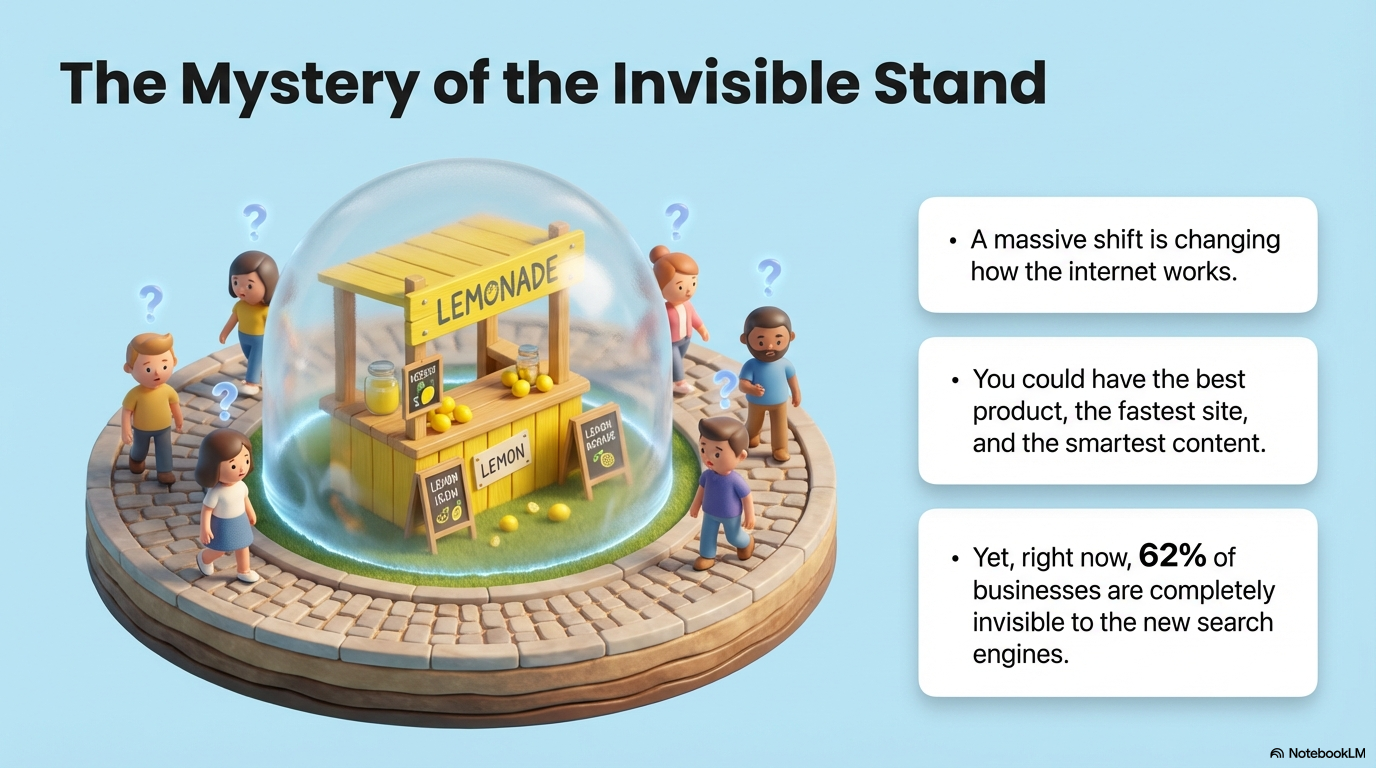
A massive shift is changing how the internet works. You could have the best product, the fastest site, and the smartest content.
Yet right now, 62% of businesses are completely invisible to the new search engines — the AI-powered ones like ChatGPT, Google AI Overview, Perplexity, and voice assistants.
This course explains why it's happening and gives you 7 concrete pillars to fix it. No jargon. No fluff. About 15 minutes.
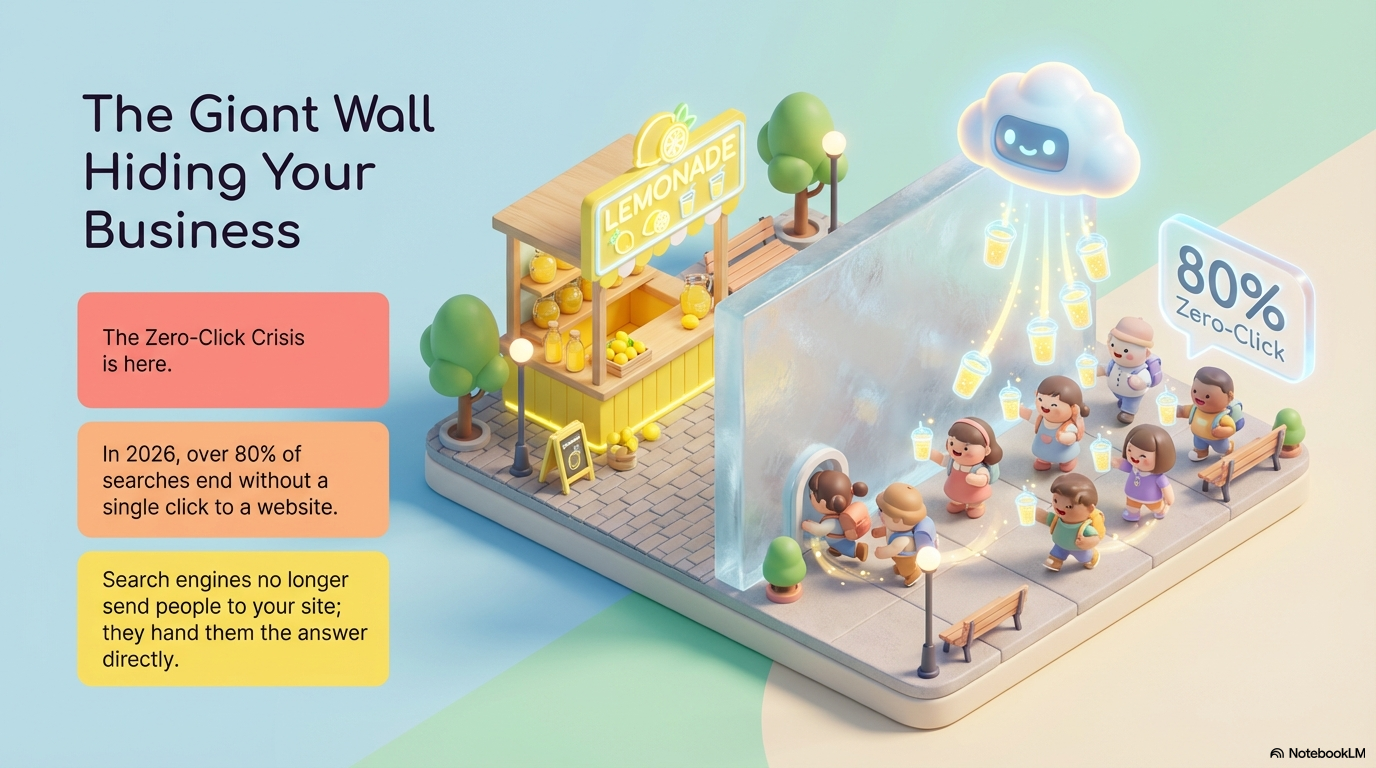
The Zero-Click Crisis is here. In 2026, over 80% of searches end without a single click to a website.
Search engines no longer send people to your site — they hand them the answer directly. Google's AI Overview, ChatGPT, voice assistants — they all pull the answer from someone's content and serve it up instantly.
If that content isn't yours, you're the lemonade stand behind the giant wall.
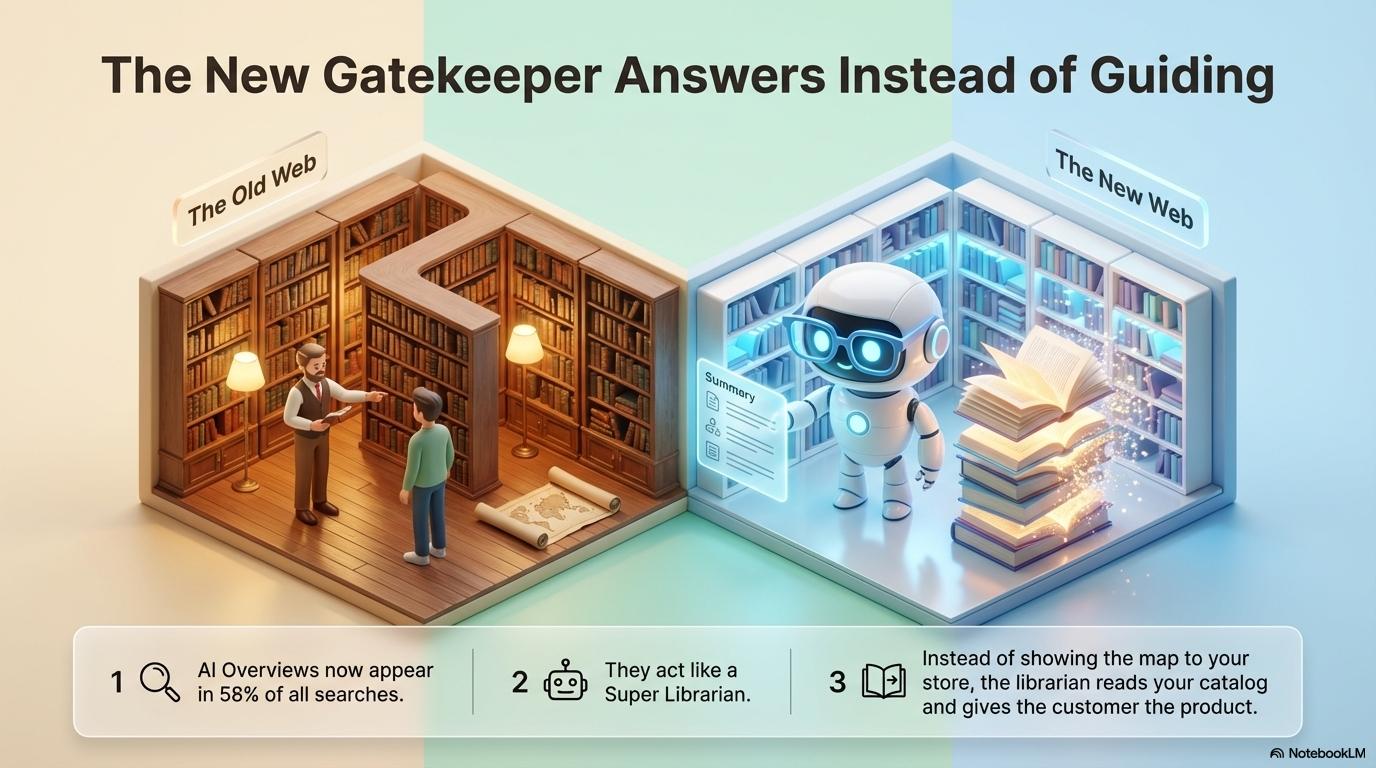
AI Overviews now appear in 58% of all searches. They act like a Super Librarian — instead of showing the map to your store, the librarian reads your catalog and gives the customer the product.
The old web: "Here are 10 links, go find your answer."
The new web: "Here IS the answer. You're welcome."
Your website either feeds the librarian or gets ignored by it.
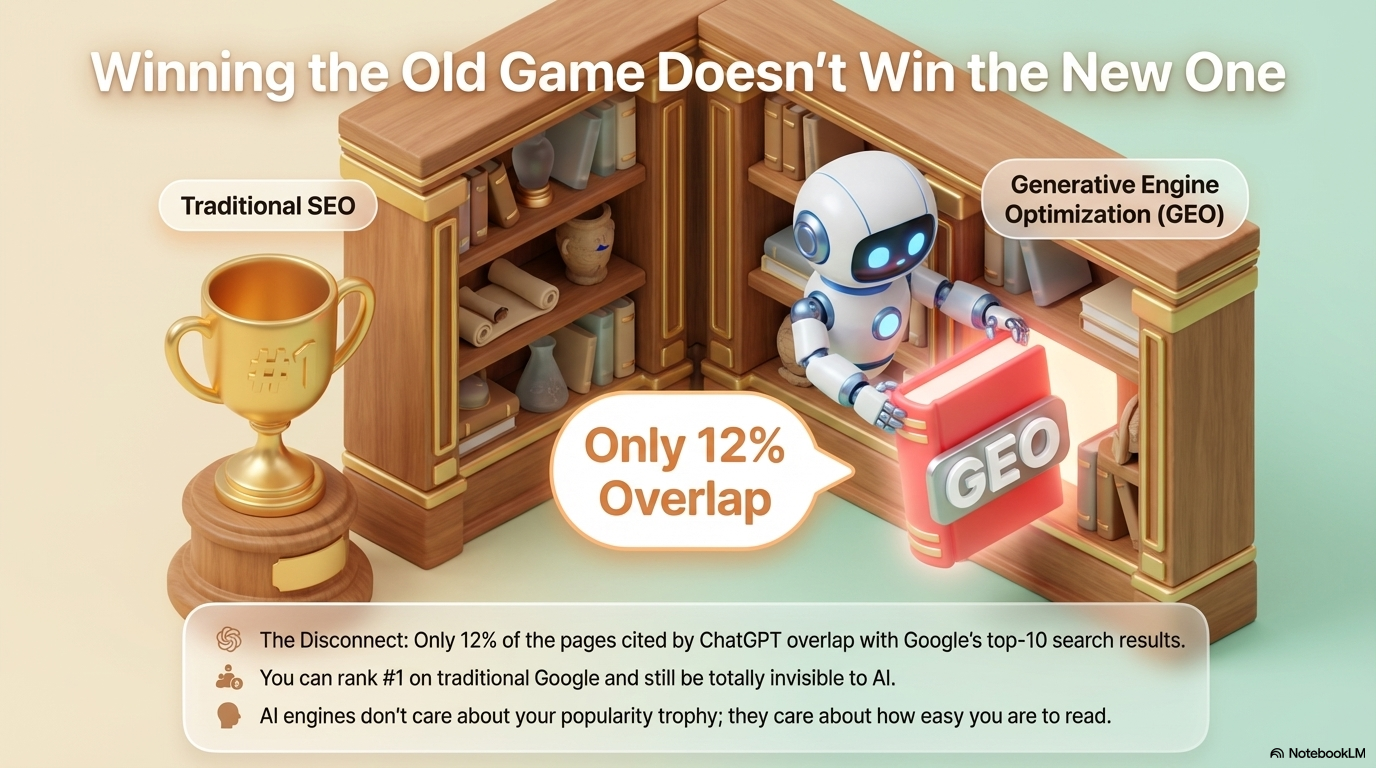
Here's the stat that changes everything: Only 12% of the pages cited by ChatGPT overlap with Google's top-10 search results.
That means you can rank #1 on traditional Google and still be totally invisible to AI.
AI engines don't care about your popularity trophy. They care about how easy you are to read.
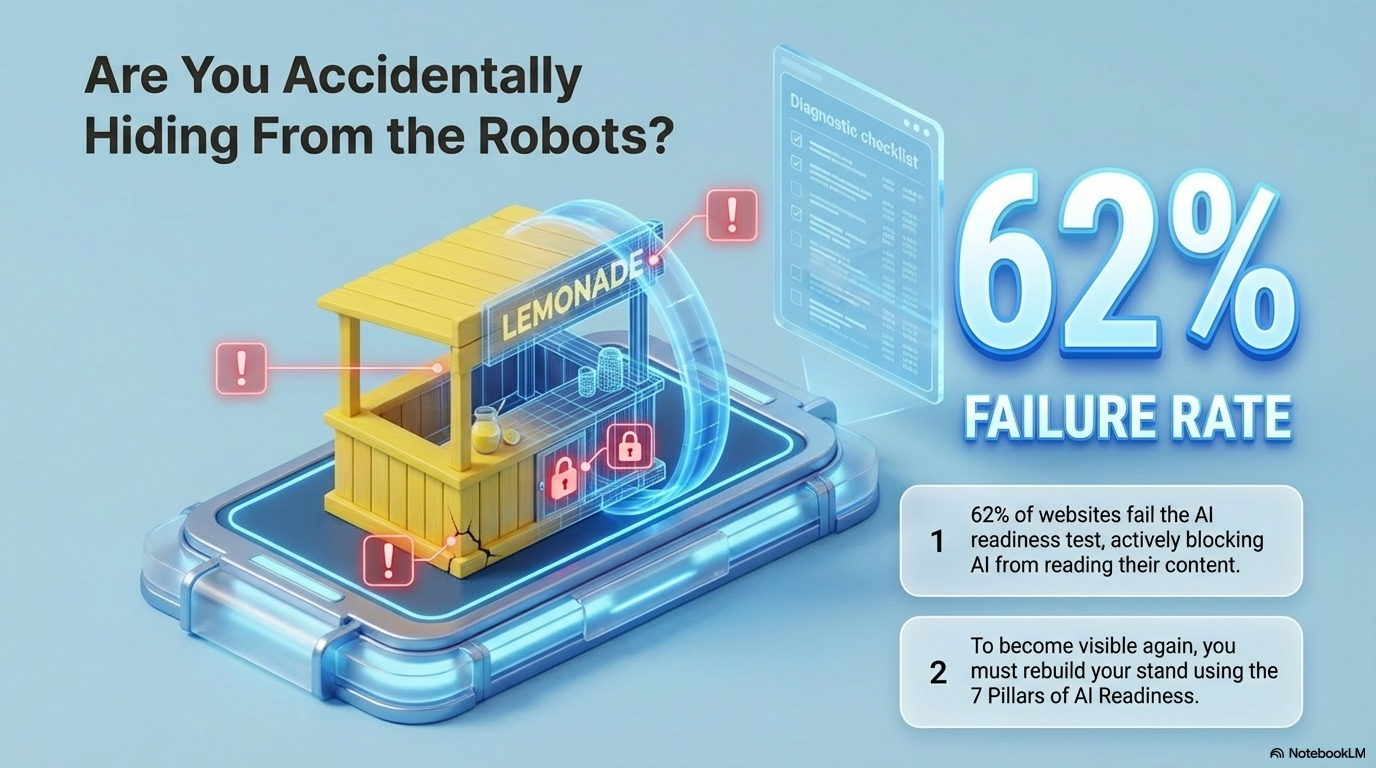
62% of websites fail the AI readiness test, actively blocking AI from reading their content. Not on purpose — by accident.
Outdated robots.txt rules, missing schema markup, content buried in JavaScript, no structured data — all of these make your site invisible to the very AI systems that could be recommending you.
To become visible again, you need the 7 Pillars of AI Readiness.
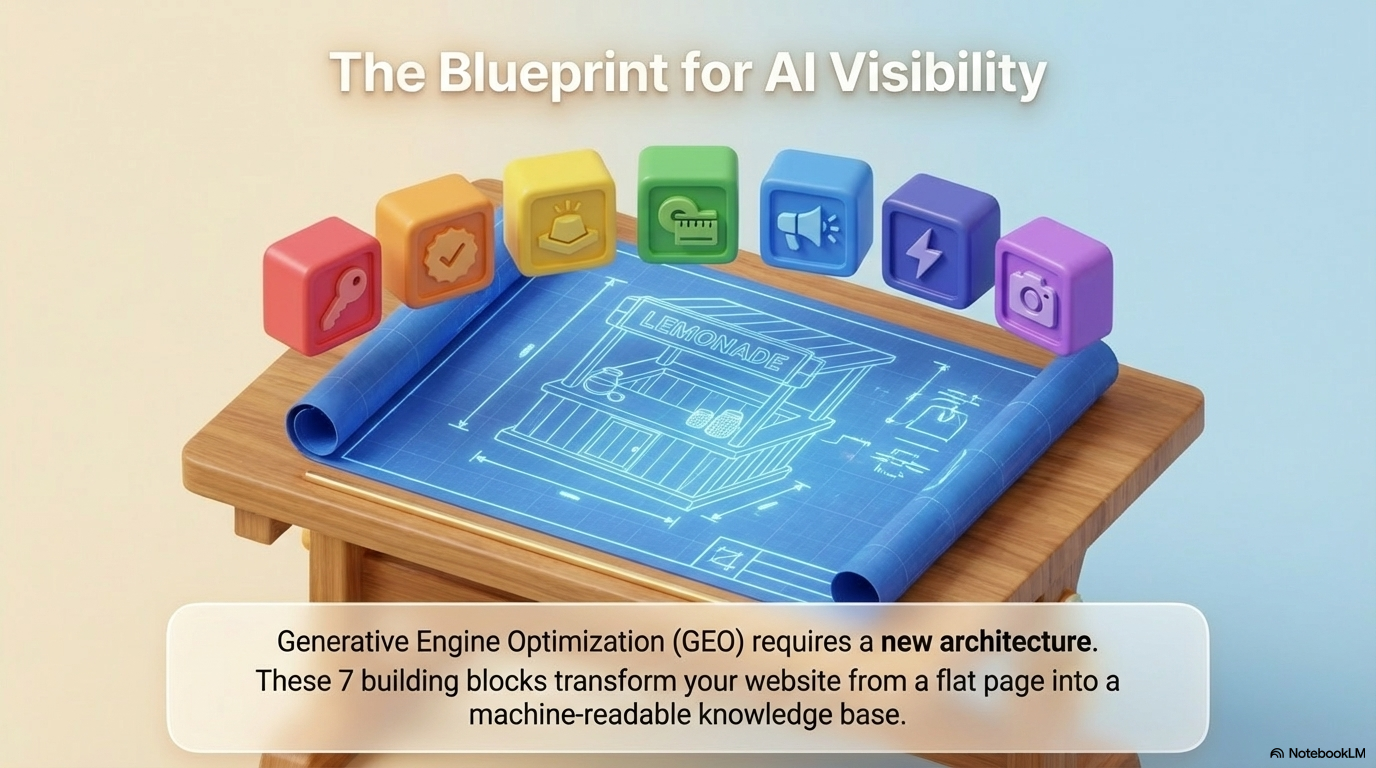
Generative Engine Optimization (GEO) requires a new architecture. These 7 building blocks transform your website from a flat page into a machine-readable knowledge base.
Think of it like remodeling a house. The old house was built for human visitors who walk through the front door. The new house needs a drone landing pad on the roof — because the AI bots arrive from above.
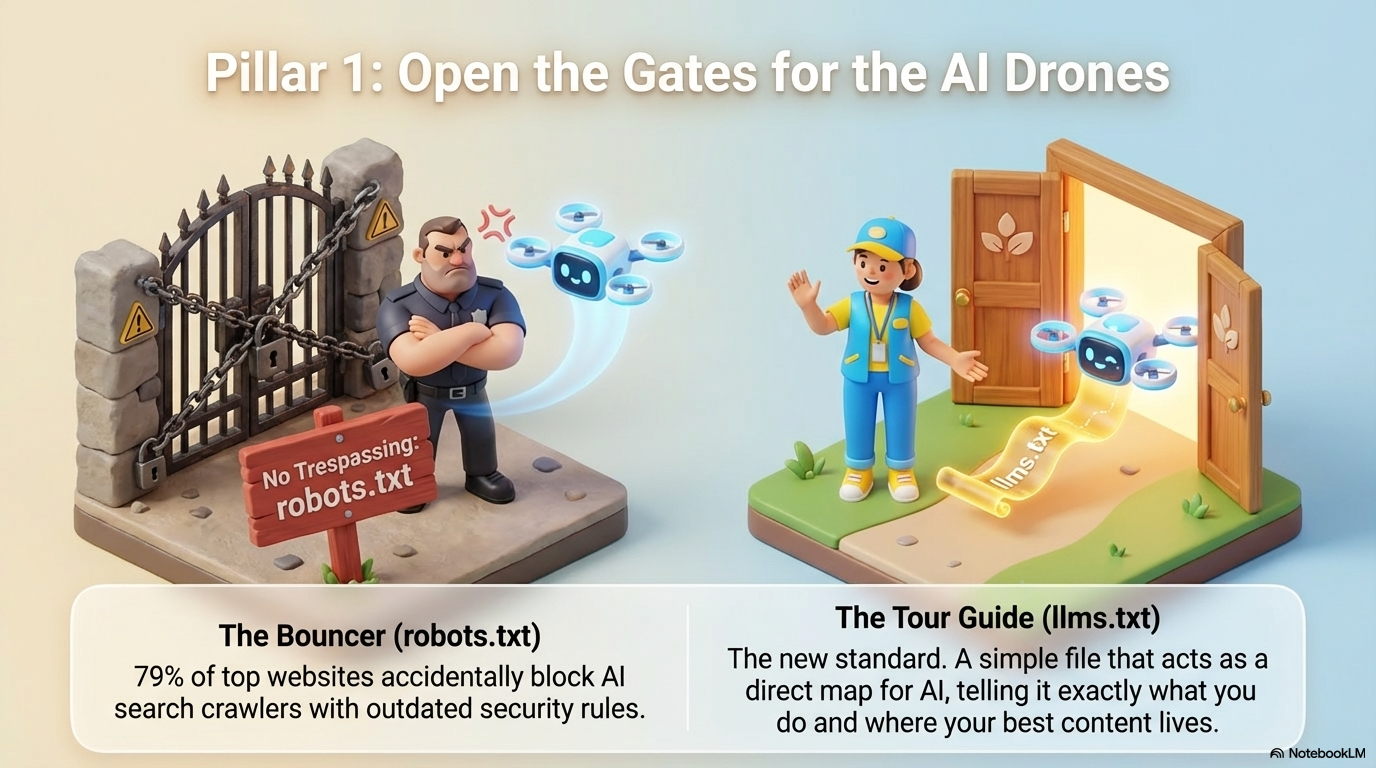
The Bouncer (robots.txt): 79% of top websites accidentally block AI search crawlers with outdated security rules. Your robots.txt file might be telling ChatGPT, Claude, and Perplexity to stay out.
The Tour Guide (llms.txt): A simple new file that acts as a direct map for AI, telling it exactly what you do and where your best content lives. Only 5% of websites have one — massive first-mover advantage.
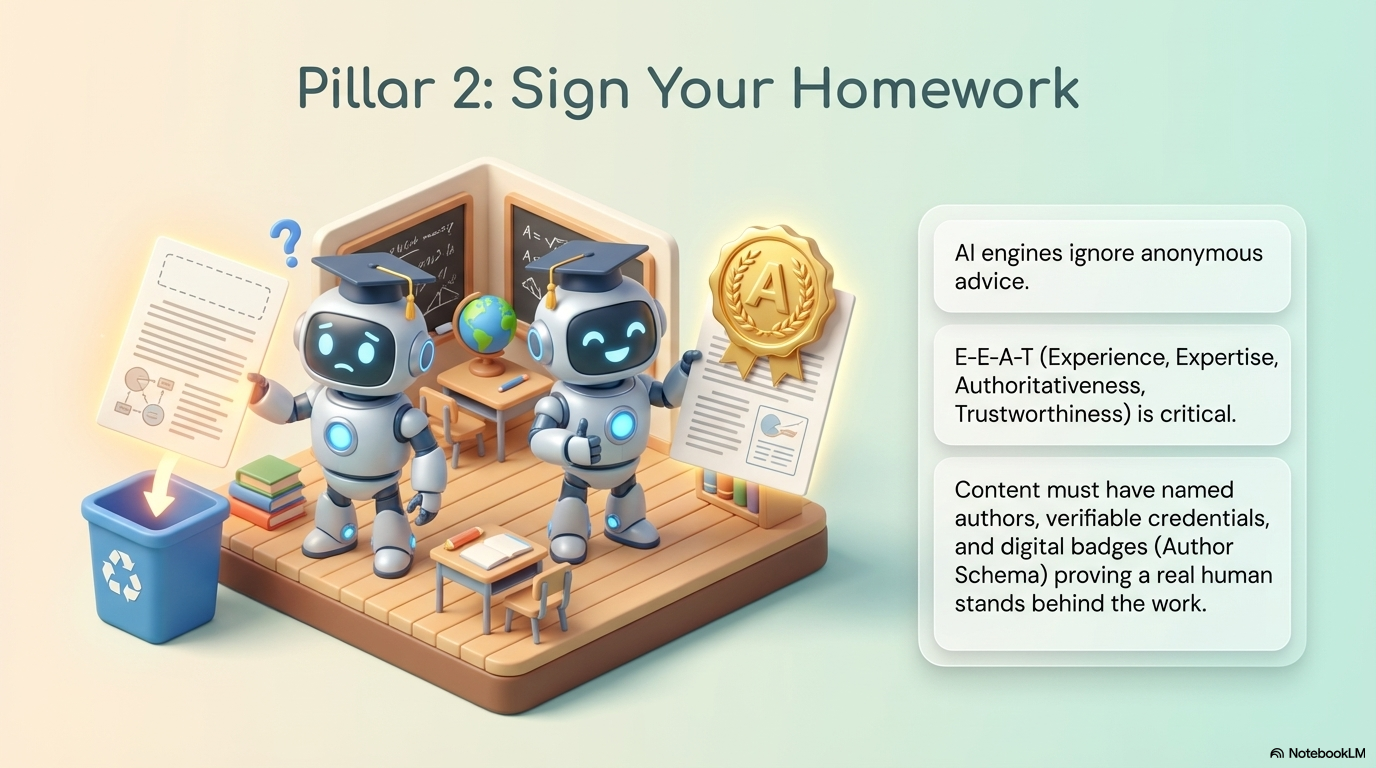
AI engines ignore anonymous advice. E-E-A-T (Experience, Expertise, Authoritativeness, Trustworthiness) is critical.
Content must have named authors, verifiable credentials, and digital badges (Author Schema) proving a real human stands behind the work.
Think of it this way: would you trust medical advice from "Admin" or from "Dr. Sarah Chen, MD, 15 years in cardiology"? AI thinks the same way.
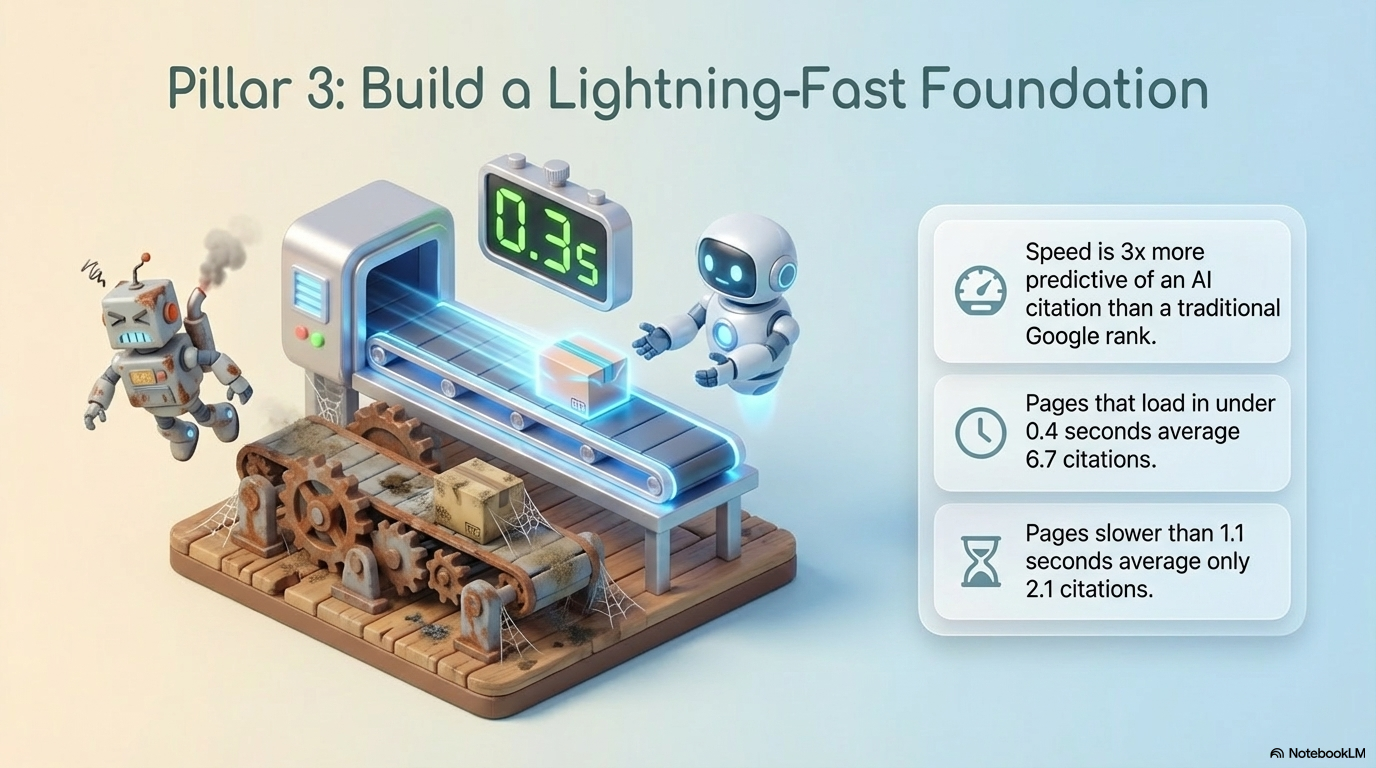
Speed is 3x more predictive of an AI citation than a traditional Google rank.
Pages that load in under 0.4 seconds average 6.7 citations. Pages slower than 1.1 seconds average only 2.1 citations.
AI crawlers have deadlines. If your page takes too long to load, they skip it and cite your competitor instead.
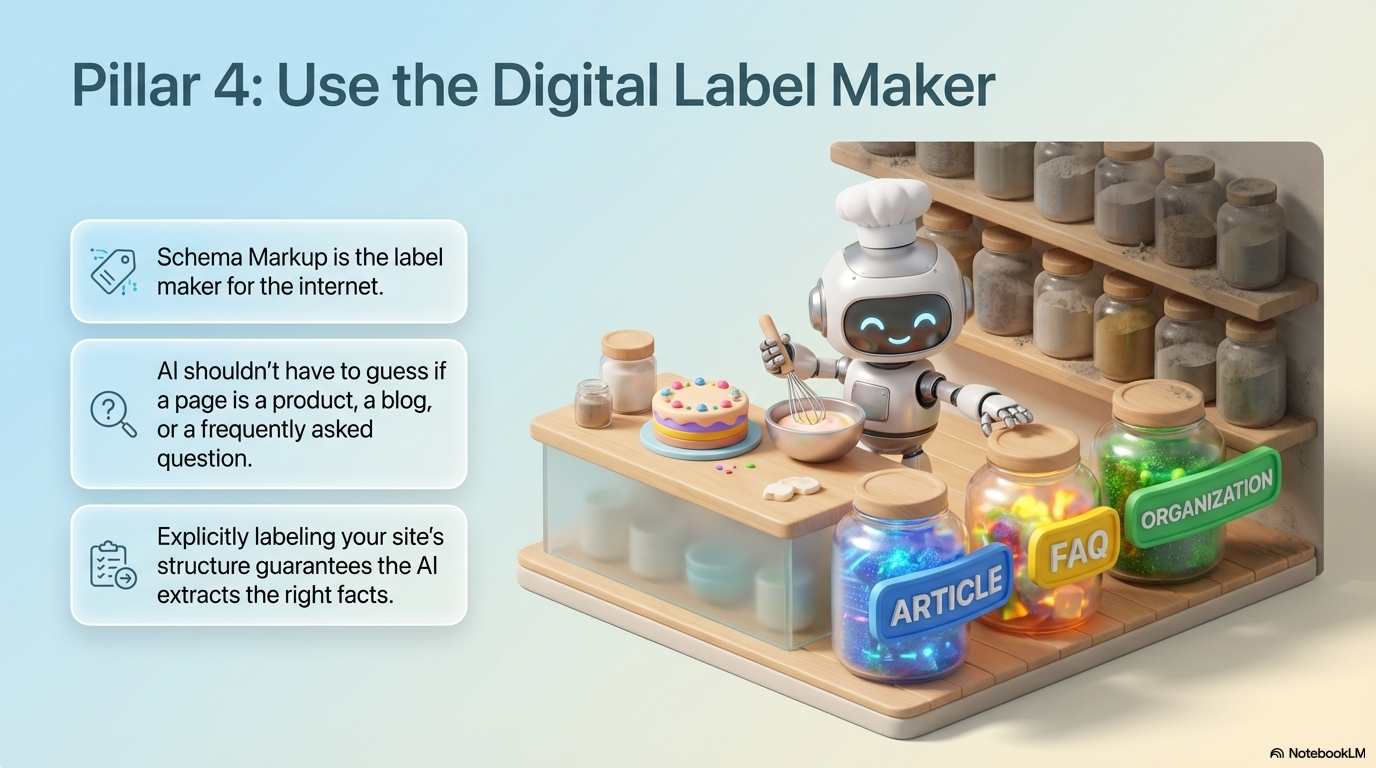
Schema Markup is the label maker for the internet. AI shouldn't have to guess if a page is a product, a blog, or a frequently asked question.
Explicitly labeling your site's structure guarantees the AI extracts the right facts. Think of it like organizing a pantry — if every jar is labeled, anyone can find the cinnamon. If nothing is labeled, good luck.
Only 31.3% of websites use schema markup, yet 72% of first-page results rely on it.
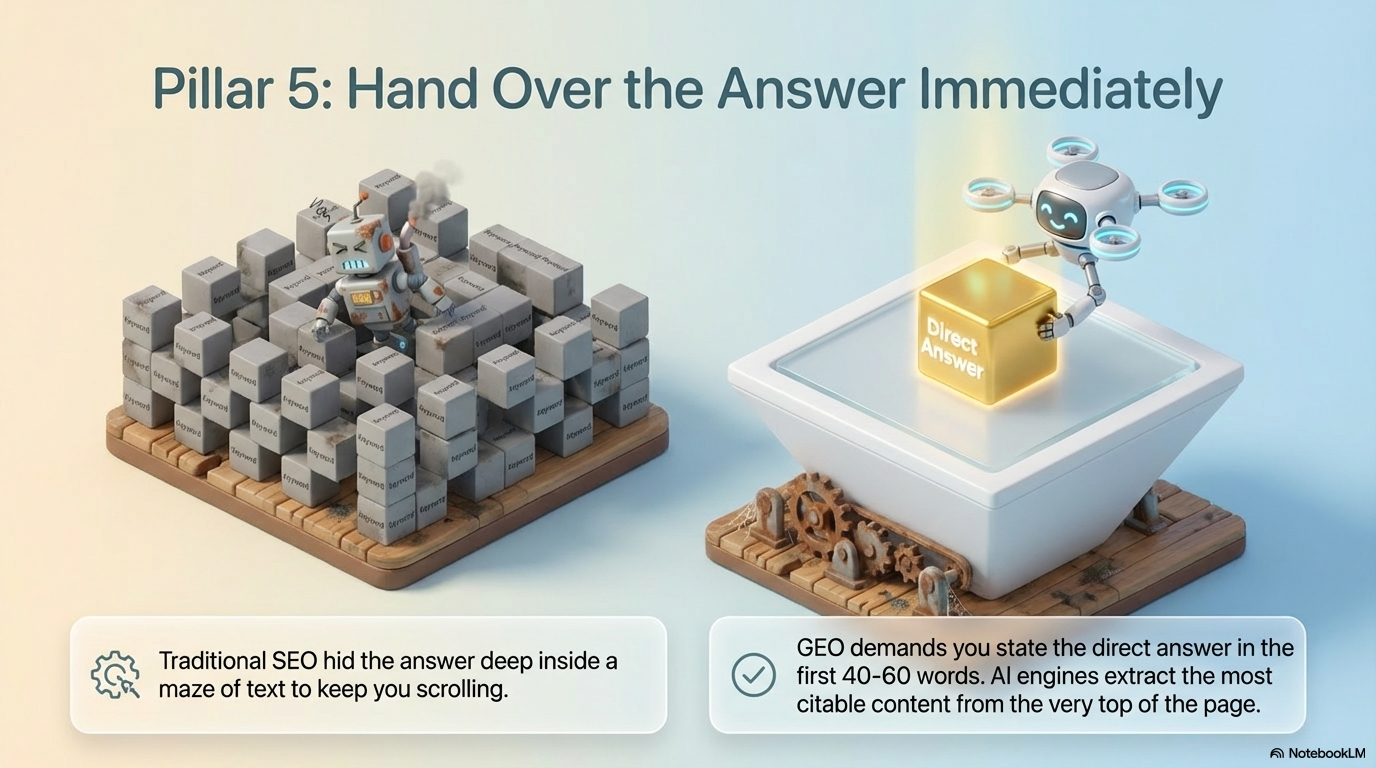
Traditional SEO hid the answer deep inside a maze of text to keep you scrolling. GEO demands the opposite.
State the direct answer in the first 40–60 words. AI engines extract the most citable content from the very top of the page.
The old game: bury the answer so they stay longer. The new game: hand over the answer so AI promotes you everywhere.
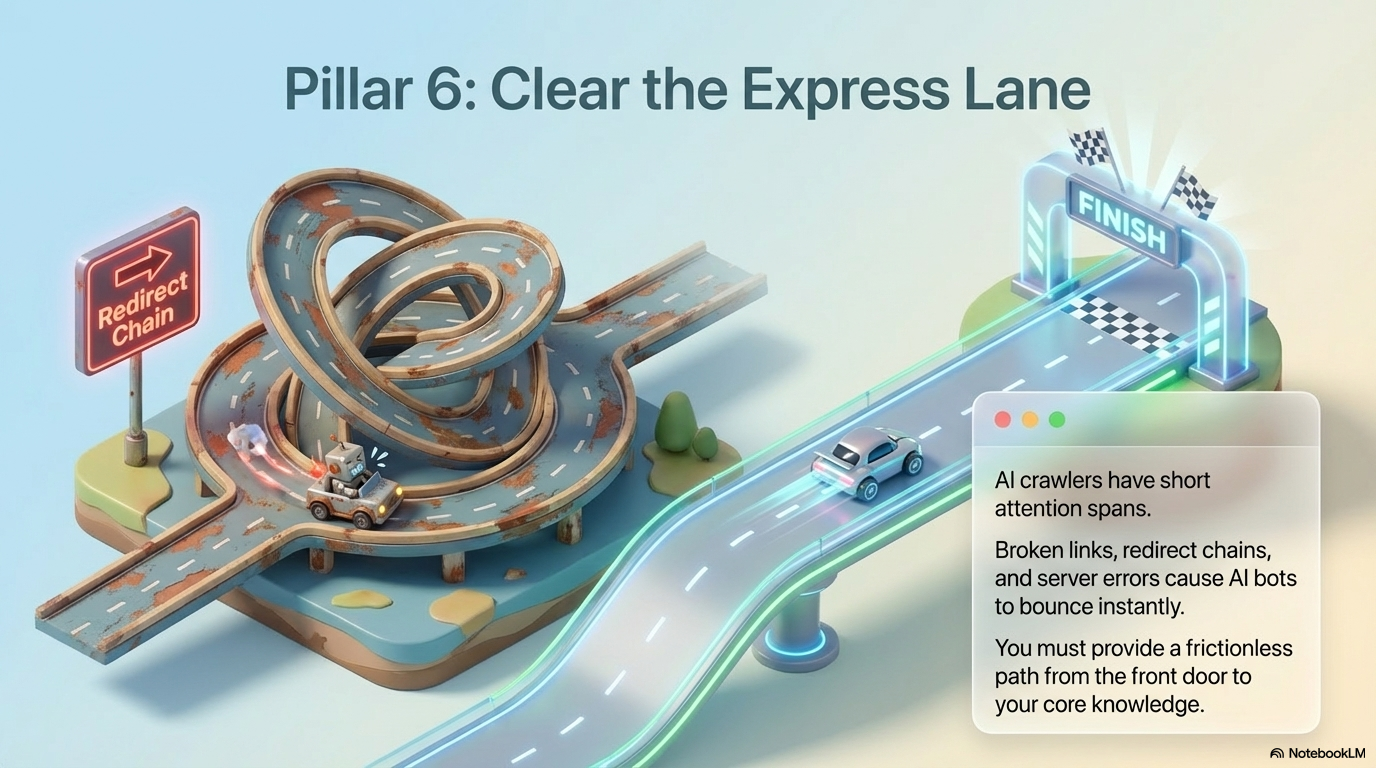
AI crawlers have short attention spans. Broken links, redirect chains, and server errors cause AI bots to bounce instantly.
You must provide a frictionless path from the front door to your core knowledge. Every 404 error, every redirect loop, every slow database query is a roadblock that makes AI skip your site entirely.
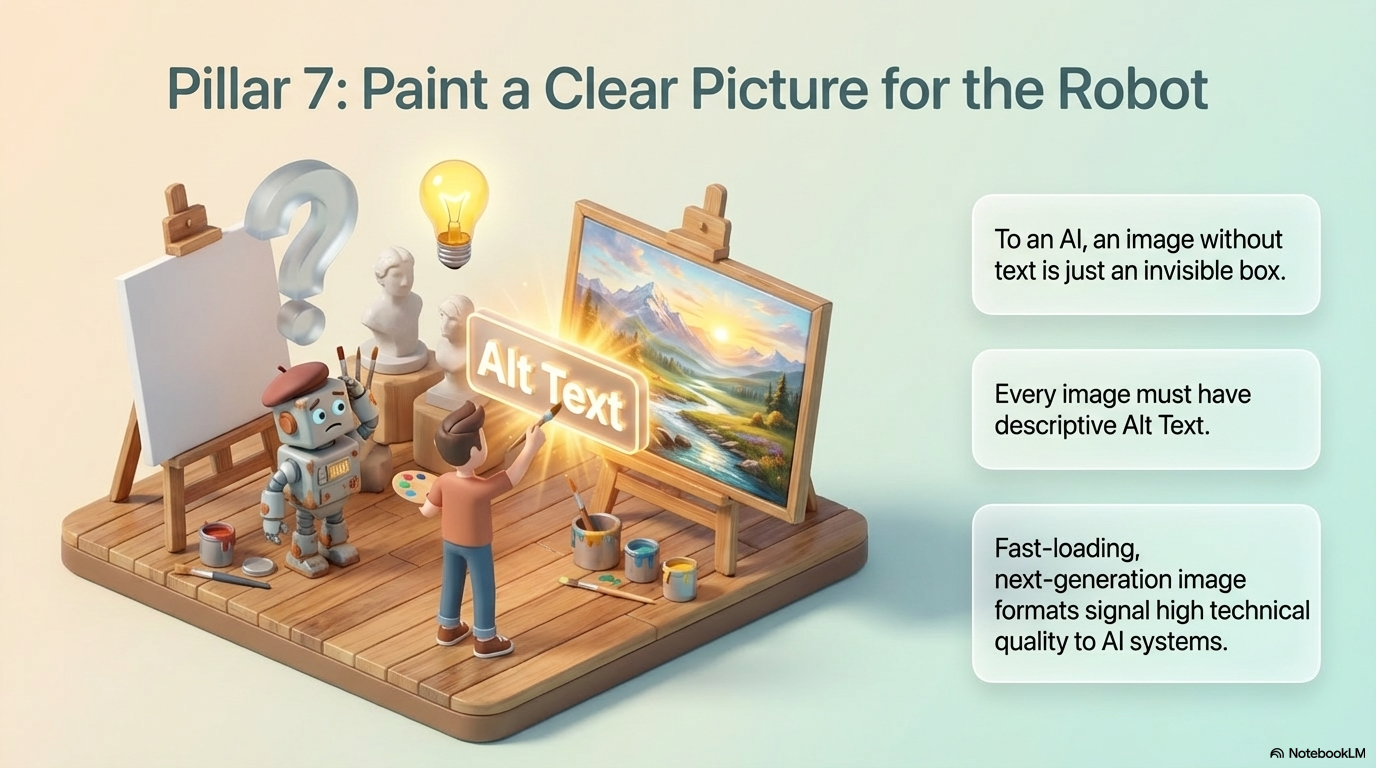
To an AI, an image without text is just an invisible box. Every image must have descriptive Alt Text.
Fast-loading, next-generation image formats signal high technical quality to AI systems. WebP and AVIF images load faster and tell AI crawlers that your site is modern and well-maintained.
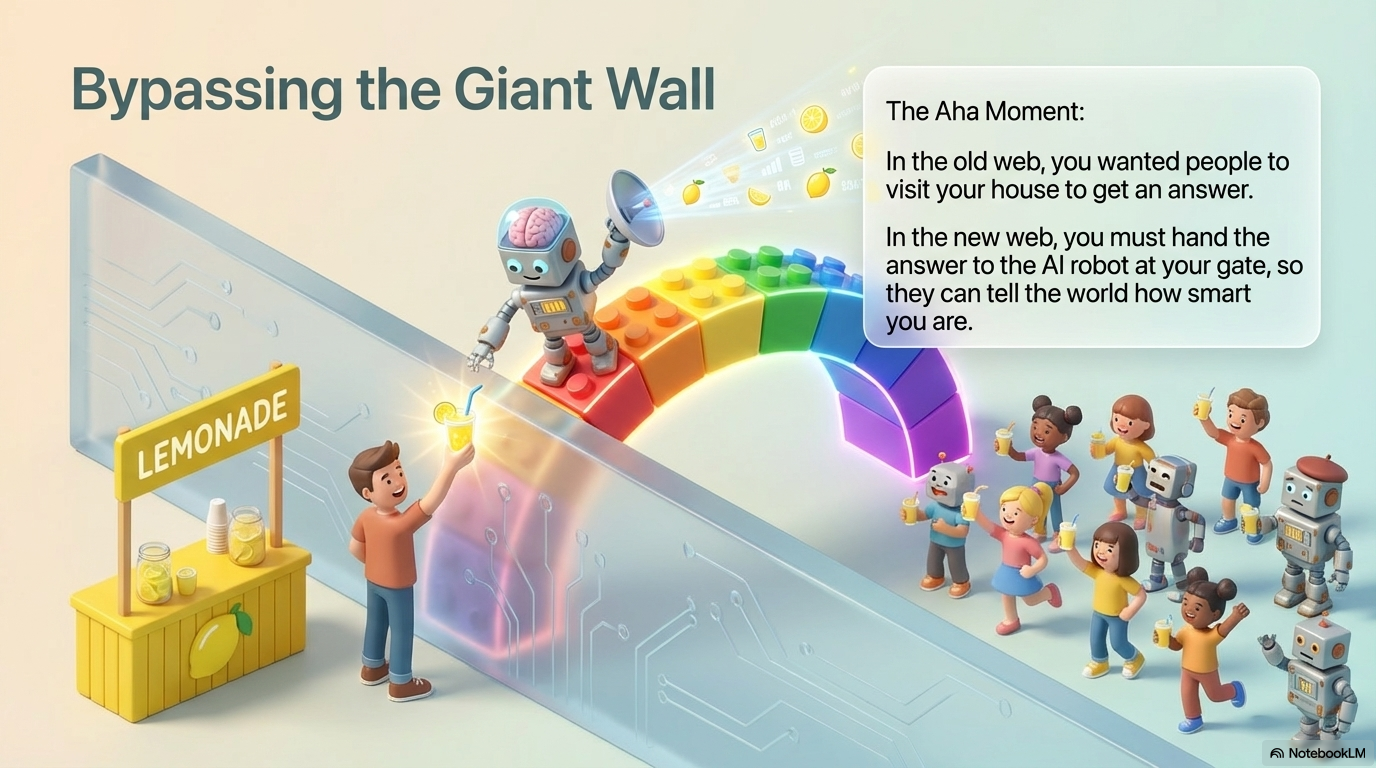
In the old web, you wanted people to visit your house to get an answer.
In the new web, you must hand the answer to the AI robot at your gate, so they can tell the world how smart you are.
The businesses that understand this shift will dominate the next decade. The ones that don't will wonder why their traffic disappeared.
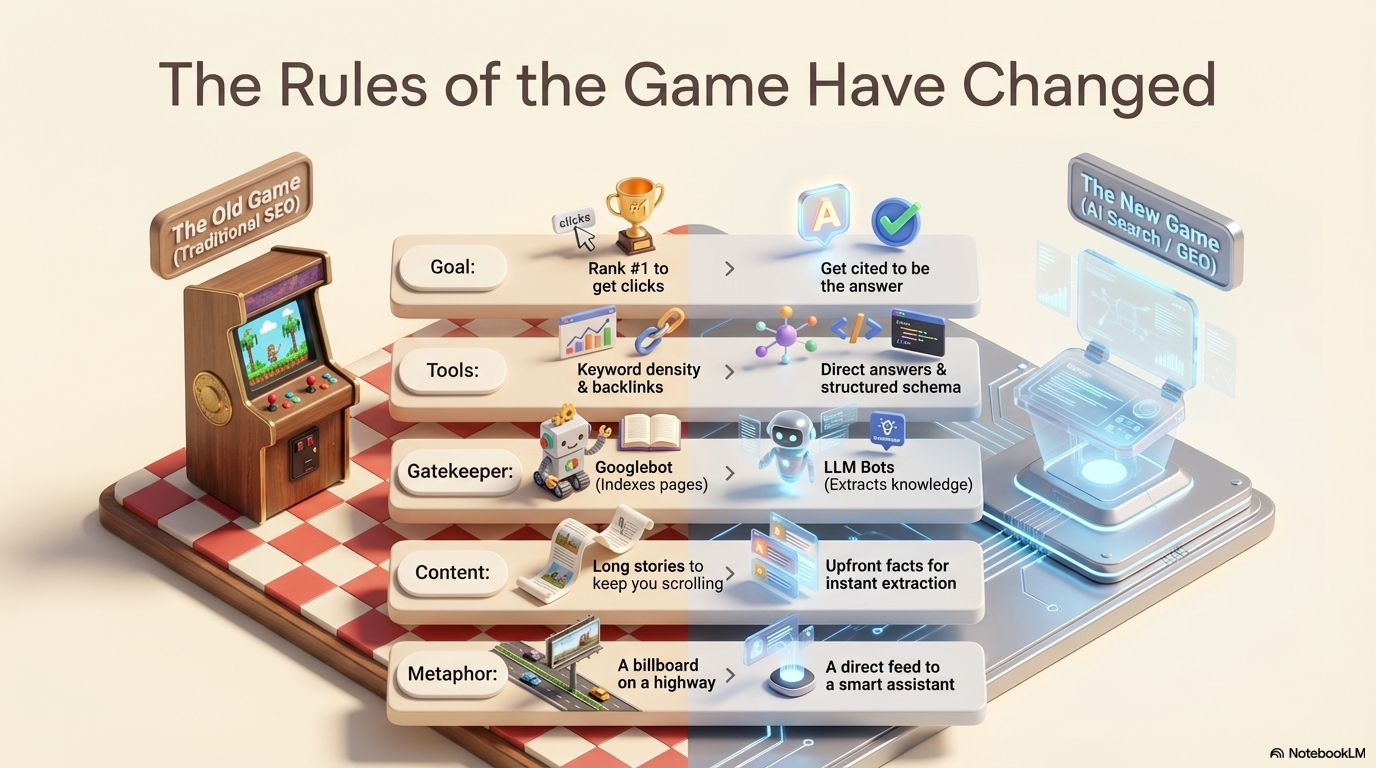
The Old Game (Traditional SEO): Goal was to rank #1 to get clicks. Tools were keyword density and backlinks. Content was long stories to keep you scrolling. Metaphor: a billboard on a highway.
The New Game (AI Search): Goal is to be cited as the answer. Tools are direct answers and structured schema. Content is upfront facts for instant extraction. Metaphor: a direct feed to a smart assistant.
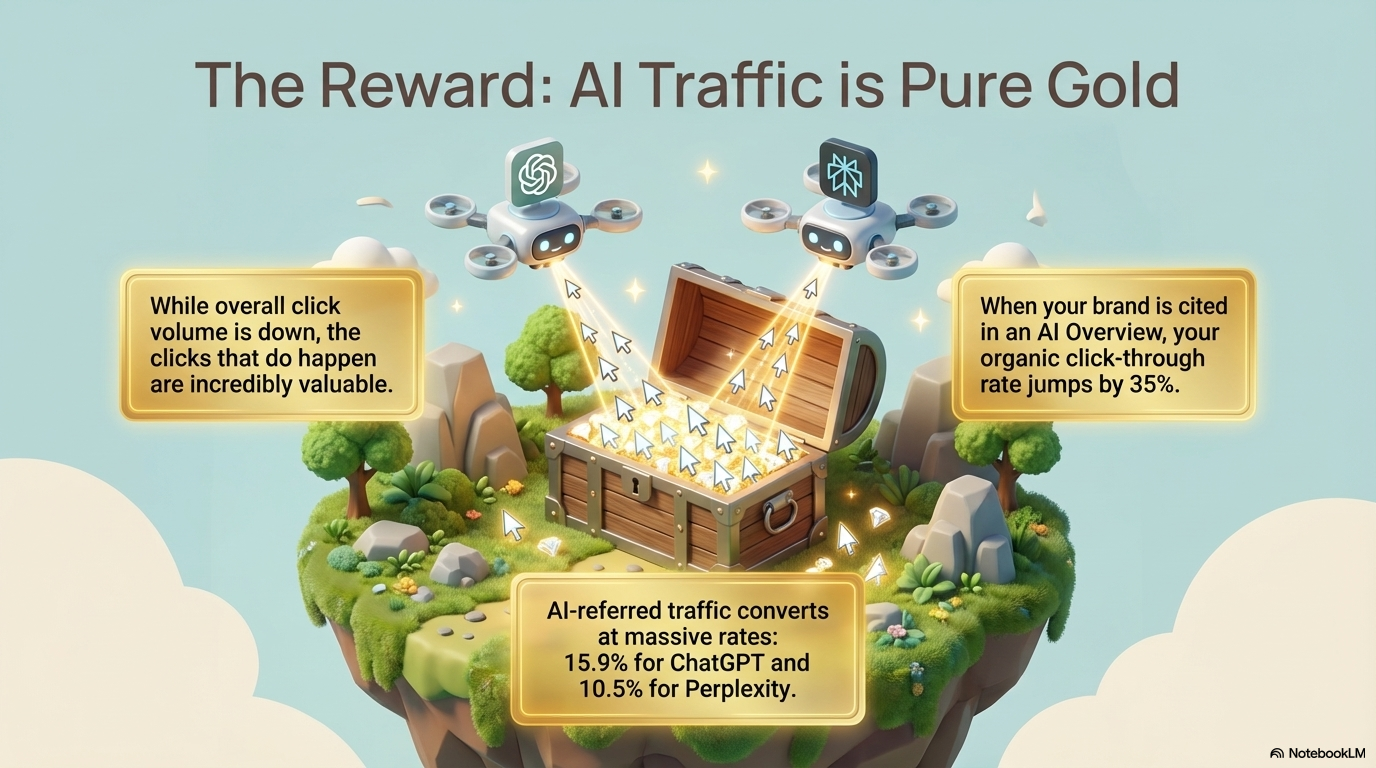
While overall click volume is down, the clicks that DO happen are incredibly valuable.
When your brand is cited in an AI Overview, your organic click-through rate jumps by 35%.
AI-referred traffic converts at massive rates: 15.9% for ChatGPT and 10.5% for Perplexity. Compare that to the typical 2-3% conversion rate from traditional search. The visitors AI sends you are pre-qualified — they already trust the recommendation.
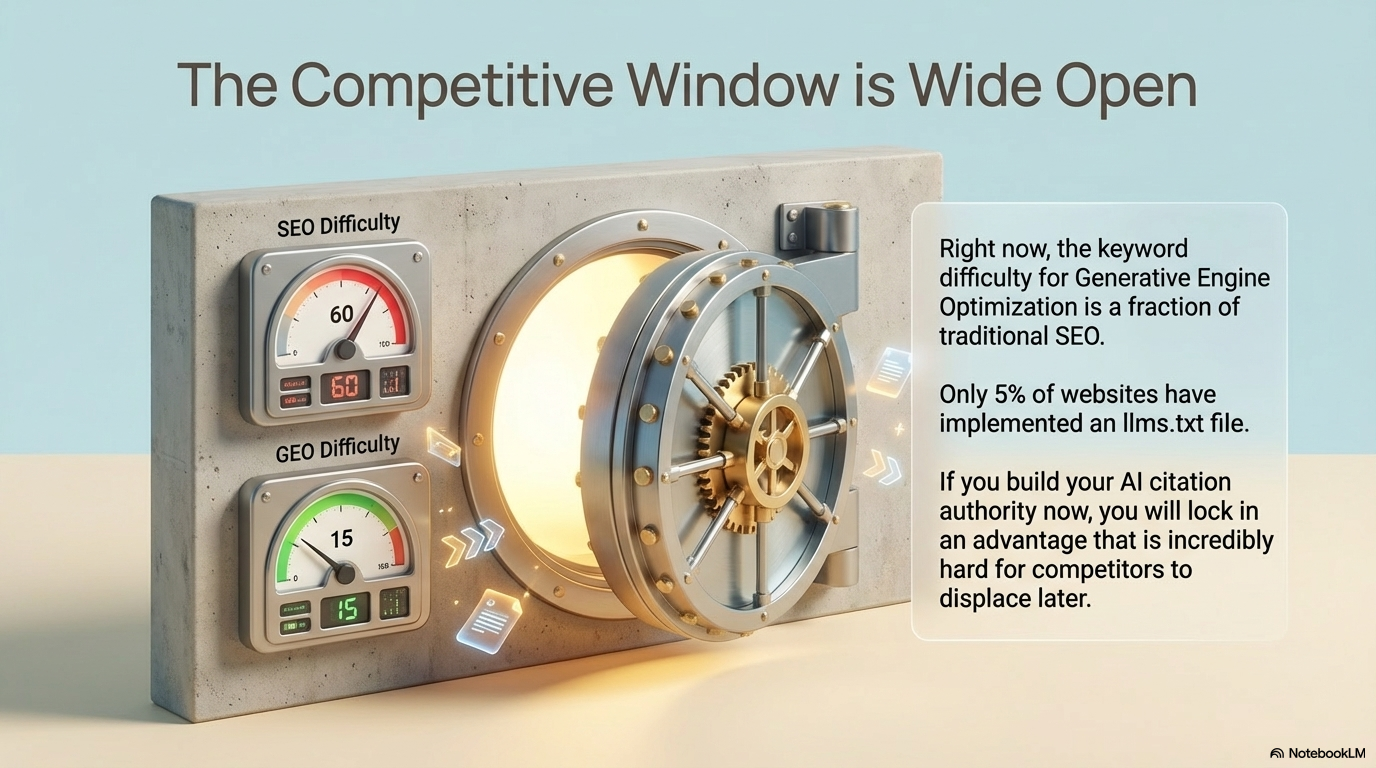
Right now, the keyword difficulty for Generative Engine Optimization is a fraction of traditional SEO. Only 5% of websites have implemented an llms.txt file.
If you build your AI citation authority now, you will lock in an advantage that is incredibly hard for competitors to displace later.
This is the equivalent of buying a domain name in 1995. The window won't stay open forever.
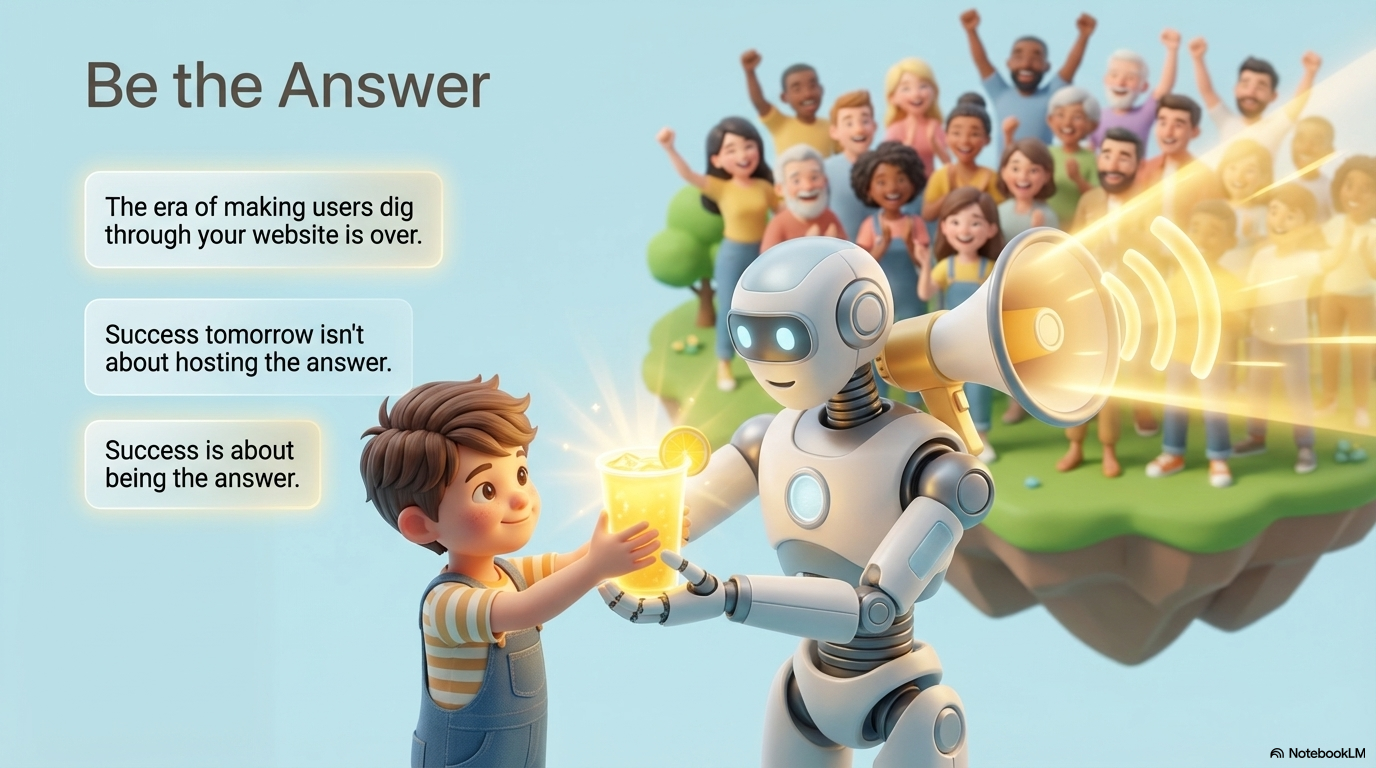
The era of making users dig through your website is over. Success tomorrow isn't about hosting the answer. Success is about being the answer.
Implement the 7 pillars. Open the gates, sign your work, build fast, label everything, lead with answers, clear the path, and paint the picture. Do this and AI will make you famous.
How Visible is YOUR Website to AI?
You've learned the 7 pillars. Now find out where your business stands with an automated AEO Visibility Scan.